
How Johan Cruijff helped me understand the limitations of the Greenhouse Gas Protocol
A new contribution from Reinier de Adelhart Toorop, our Expert Contributor, Head of Research at Impact Institute and lecturer at Erasmus University Rotterdam focuses on real blind spots in impact measurement and sustainability.
I recently came across this newspaper ad from the 1970s featuring former Dutch football player Johan Cruijff.

Cruijff promotes a ‘healthy’ cigarette. Now we would all see this as highly immoral and, in fact, it is forbidden to market less unhealthy cigarettes as such. (And yes, I know some people discussed vaping in this language a few years ago – fortunately we now all know vaping for what it is.)
The point is not that the message is wrong. Indeed, Roxy cigarettes might be marginally less unhealthy due to the reduced tar and nicotine levels. But it remains a cigarette. Given the limited ability of people to process information, the message about smoking should be simple. Don’t smoke. Quit now.
This ad illustrates a classic problem in sustainability: something can be better than the alternative, while still being fundamentally harmful.
In impact terms, Roxy cigarettes have a (small) positive marginal impact, while they have a (large) negative absolute impact. To understand what these concepts mean, we look at the impact pathway. This can be used to define impact. In fact, the impact of an activity is the difference between the outcomes of that activity and those of the reference activity.
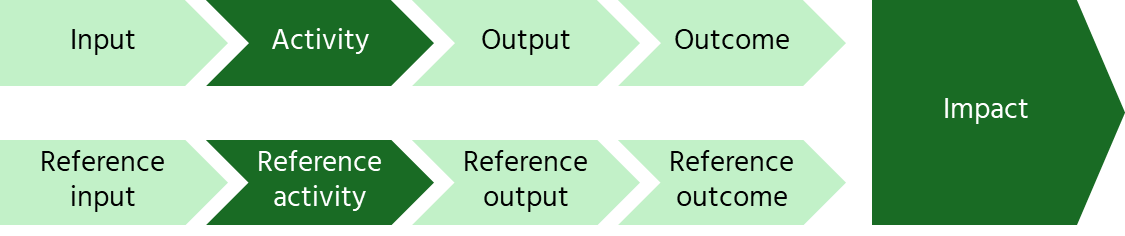
Now, the crux is that there is no clear right or wrong when it comes to what the reference should be. For the Roxy cigarette, should it be any other cigarette, or no cigarette at all? Teslas are luxury electric cars. Should their reference be a luxury internal combustion car? The ‘car mix’ (all luxury and economy cars on the road)? The ‘transportation mix’ (all forms of transportation)? Or simply no cars – and no emissions at all?
Marginal impact assumes a reasonable alternative. Absolute impact assumes simply no activity. That may seem very far-fetched, but it turns out to be crucial in understanding how sustainable a company really is – and whether the world can bear its burden.
When I interview new people for Impact Institute, we often do a recruitment case based on the lifetime emissions of a wind turbine. Almost every candidate initially assumes the answer will be zero. After all, when it runs, the turbine emits close to no carbon. But during construction it does not. Steel, aluminum and concrete (which its base is made of) are all very carbon-intensive materials.
During the interview, we calculate (quite literally on the back of an envelope) the carbon footprint of wind energy. While this is much less than fossil fuel-based electricity, it is still substantial at around 10 grams of CO₂ per kWh. Even if the entire world could switch to wind energy today, the lifecycle emissions would still add up to around 300 megatons. That may sound small, but it is roughly equal to the annual emissions of a country like Italy. And with electricity demand rising rapidly – driven by electrification, data centers and AI – this number would only grow.
In that sense, wind energy is a bit like the Roxy cigarette in Cruijff’s ad. It has positive marginal impact (it is better than the direct alternatives), but it still has a negative absolute impact (it is associated with very real emissions). The same tension exists for electric cars, green hydrogen and many other so-called sustainable solutions.
The key lesson is simple: being better than the alternative does not automatically make something sustainable.
If we want better (planetary) health, we should switch to new forms of energy, but we should also simply reduce our energy use. We cannot fully innovate ourselves out of the problem.
As I wrote in an earlier newsletter, climate debates are often shaped by two types of thinkers: wizards and prophets. Wizards focus on technological breakthroughs that reduce the impact of what we do. Prophets focus on changing behaviour so we simply do less of it. In reality, we need both.
To switch energy types and to limit energy use, we need the right incentives. At the corporate level, taxation and subsidies are key elements – the classical sticks and carrots. For subsidies, it is crucial that these target only technologies that have a large positive marginal impact but that also do not have too large a negative absolute impact. Otherwise we may end up trapped in a solution that still surpasses the earth’s boundaries.
In addition to taxation and subsidies, transparency is also key. Companies should be honest about their emissions. Unfortunately, current carbon accounting rules sometimes obscure this distinction. The problem lies in the definition of scope 2 according to the Greenhouse Gas Protocol.

Scope 2 is defined as a company’s indirect emissions from its purchased electricity, steam, heating and cooling for its own use. Or, more specifically, the direct emissions (scope 1) of their utility supplier. Now, a company that operates wind turbines may have zero scope 1 emissions. The emissions occur in their scope 3 – upstream activities that enable the wind turbines to be there in the first place (“purchased goods”).
As a result, many companies now report zero scope 2 emissions. It is a correct application of the Greenhouse Gas Protocol, but it gives the false impression that electricity-related emissions are under control and that switching energy was sufficient. No reduction of energy use would be necessary. Really mitigating climate change also requires keeping an eye on the “scope 3 of scope 2”.
Or, as Johan Cruijff would say: “Maar dat is logisch”.


